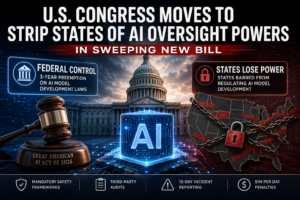


The fight between AI safety advocates and an administration pushing to accelerate AI development has moved from political rhetoric into federal court. On April 24, 2026, the US Department of Justice intervened in a lawsuit filed by Elon Musk’s xAI against Colorado’s first-in-the-nation AI antidiscrimination law, marking the first time the agency has directly joined a private challenge to a state AI statute.
The intervention is the practical execution of an executive order President Trump signed on December 11, 2025, titled “Ensuring a National Policy Framework for Artificial Intelligence.” That order created a DOJ AI Litigation Task Force with a single mandate: sue states whose AI laws the administration considers too burdensome on industry. Attorney General Pam Bondi announced the task force on January 9, 2026, instructing it to coordinate with David Sacks, the White House’s AI and crypto advisor, on which state laws to target first.
Colorado’s law became the first target. Senate Bill 24-205, known as the Colorado AI Act, was signed in 2024 and required developers and deployers of “high-risk” AI systems to exercise reasonable care against algorithmic discrimination, which the statute defines as differential treatment that disadvantages people based on protected characteristics such as race, sex, or disability. The law was scheduled to take effect June 30, 2026.
xAI sued to block the law on April 9, arguing it would force AI systems to produce inaccurate, demographically adjusted outputs. Two weeks later, DOJ filed its own complaint in intervention, arguing the law violates the Equal Protection Clause by compelling companies to engineer their models around demographic outcomes. On April 27, a federal court in Denver granted a joint motion staying enforcement of the law while litigation continues.
A Law Already in Retreat
The legal pressure produced a legislative outcome before the case reached a ruling on the merits. On May 14, 2026, the Colorado Senate passed SB 26-189, which repeals and reenacts the original AI Act with a substantially narrower framework focused specifically on automated decision-making in consequential matters such as employment, housing, and lending. The revised law is scheduled to take effect January 1, 2027, dropping many of the broader obligations that triggered the original lawsuit.
Colorado state representative Brianna Titone, one of the bill’s original sponsors, rejected the framing that the law was simply withdrawn under pressure. Titone said the law was always intended to curb discrimination in consequential decisions and that lawmakers were continuing to push for accountability from AI companies regardless of the litigation. DOJ attorneys, in their filing, argued the opposite, contending that Colorado’s law would “disproportionately burden small businesses and start-ups” while undermining the country’s position as the leading AI developer globally.
The Executive Order’s Wider Reach
The Colorado case sits inside a much broader strategy. Trump’s executive order directs the Commerce Department to publish, by March 11, 2026, an evaluation identifying “onerous” state AI laws that could be referred to the litigation task force, and instructs the Federal Trade Commission to issue guidance on how existing federal consumer protection law applies to AI models. The order also threatens to withhold federal broadband infrastructure funding from states whose AI laws the administration deems excessive.
Legal analysts have been skeptical that the order’s underlying theory will hold up. John Bergmayer, legal director at the advocacy group Public Knowledge, argued that the administration’s commerce clause theory misreads existing precedent, pointing to a 2023 Supreme Court ruling that upheld California’s authority to regulate its pork industry even though the rule affected out-of-state producers. Law firm Gibson Dunn reached a similar conclusion in its own analysis, writing that neither the preemption nor the interstate commerce theories in the order are likely to succeed in court, and advising companies to continue complying with existing state AI laws in the meantime.
The order does carve out exceptions. Unlike an earlier leaked draft, the final text exempts state laws covering child safety, AI compute and data center infrastructure, and state government procurement from any preemption push, a change widely attributed to pressure from Republican-controlled states such as Florida that have passed their own AI consumer protection measures.
Congress Has Tried and Failed Twice
The administration turned to executive action only after legislative efforts collapsed twice in 2025. Senate Republicans, led by Senator Ted Cruz of Texas, attempted to insert a ten-year moratorium on state AI regulation into the Republican reconciliation bill, but the Senate voted 99 to 1 to strip the provision in July 2025. A second attempt to fold AI preemption into the National Defense Authorization Act also failed later that year.
Senator Ed Markey of Massachusetts has positioned himself as the leading congressional opponent of federal preemption, introducing the States’ Right to Regulate AI Act in December 2025 specifically to block enforcement of Trump’s executive order. Markey has repeatedly tied the preemption push to industry political donations, arguing the order rewards “Big Tech’s campaign donations” at the expense of consumer protection. Hundreds of organizations, including labor unions, civil rights groups, and consumer protection nonprofits, signed letters to Congress opposing the preemption effort when the draft order first leaked in November 2025.
The opposition is not confined to one party. Reporting from CNN at the time the order was drafted noted that the preemption push has raised alarms among AI safety advocates and state lawmakers on both sides of the aisle, with critics warning that AI companies could evade accountability for harm if state oversight is removed before a federal framework exists to replace it.

What States Still Have in Place
The litigation task force’s campaign has not stopped state AI regulation broadly. California, Texas, and Illinois already have AI-related laws in effect, and Colorado’s revised statute is still moving toward implementation, just on a delayed and narrower basis. The Center for American Progress, in its analysis of the executive order, argued that states retain the constitutional authority to legislate in the absence of a comprehensive federal law and should continue doing so rather than wait for Congress to act.
That tension, a federal government trying to centralize AI policy through litigation and funding threats, against states moving forward with their own consumer protection and discrimination statutes, is likely to produce more cases like the Colorado dispute before it produces legislative resolution. Commerce’s list of “onerous” state laws, expected since March, will determine where the task force turns next, and several law firms tracking the litigation say additional state lawsuits are likely once that list becomes public.
The Colorado case will not resolve the constitutional question on its own, but it has already reshaped the law it was filed against. Whether that pattern of federal pressure forcing legislative retreat repeats itself in California or Illinois may be the clearest signal yet of which side, speed or oversight, is currently winning the argument in practice rather than in policy papers.
Frequently Asked Questions
What is the Colorado AI Act, and why was it challenged? Colorado’s Senate Bill 24-205 required developers and deployers of high-risk AI systems to take reasonable care to prevent algorithmic discrimination against people based on protected characteristics like race, sex, or disability. Elon Musk’s xAI sued to block it in April 2026, arguing the law would force AI models to produce demographically adjusted, less accurate outputs, and the Department of Justice joined the case shortly after.
What does Trump’s AI executive order actually do? Signed December 11, 2025, the order creates a DOJ AI Litigation Task Force to challenge state AI laws considered too burdensome, directs the Commerce Department to identify problematic state laws, and threatens to withhold certain federal funding from non-compliant states. It exempts state laws covering child safety, data center infrastructure, and government AI procurement from preemption efforts.
Has Congress passed any federal AI preemption law? No. Republican attempts to include a state AI regulation moratorium in both the 2025 reconciliation bill and the National Defense Authorization Act failed, including a 99 to 1 Senate vote against the moratorium in July 2025. The executive order was issued specifically because legislative efforts to achieve the same goal collapsed twice.
Is the DOJ likely to win its legal challenges to state AI laws? Legal analysts are skeptical. Multiple law firms, including Gibson Dunn, have concluded that the commerce clause and preemption theories underlying the DOJ’s challenges are unlikely to succeed given existing Supreme Court precedent, and have advised companies to continue complying with state AI laws while litigation proceeds.
What happened to Colorado’s law after the lawsuit? Rather than waiting for a court ruling, the Colorado legislature passed a narrower replacement law, SB 26-189, in May 2026. It repeals the original statute and replaces it with a more targeted framework focused on automated decision-making in consequential matters, set to take effect January 1, 2027.
Sources
- Colorado Sun: Justice Department joins Elon Musk’s xAI in effort to block Colorado AI antidiscrimination law
- US Department of Justice: Justice Department Intervenes in xAI lawsuit Challenging Colorado’s ‘Algorithmic Discrimination’ Law
- Norton Rose Fulbright: X.AI sues, DOJ intervenes, enforcement of Colorado’s AI Act suspended
- Telehealth.org: Colorado AI Law Faces DOJ, Elon Musk Challenge
- The White House: Ensuring a National Policy Framework for Artificial Intelligence
- Gibson Dunn: President Trump’s Latest Executive Order on AI Seeks to Preempt State Laws
- CNN Business: Trump renews effort to block states from regulating AI, raising alarms about safety
- NPR: Trump is trying to preempt state AI laws via an executive order. It may not be legal
- Office of Senator Ed Markey: Senator Markey Statement on Trump Executive Order to Prohibit States from Regulating AI
- Center for American Progress: President Trump’s AI National Policy Executive Order Is an Unambiguous Threat to States Beyond Just AI
Stay in the Loop
For more stories, breakdowns, and unfiltered takes on what is really happening in Indian and global business and tech, follow TheFounder Nation.
Instagram: thefoundernation
We cover what the mainstream business press won’t.
© TheFounder Nation | All rights reserved Word count: ~1370 | Read time: ~7 minutes Primary keyword: AI safety versus speed policy fight | Secondary: Colorado AI Act, DOJ AI Litigation Task Force, state AI regulation, Trump AI executive order, federal preemption AI, algorithmic discrimination law, xAI lawsuit Meta description: Inside the US policy fight over AI safety and speed, from the DOJ’s Colorado AI Act lawsuit to Trump’s executive order on state preemption. WordPress tags: AI regulation, AI safety, Colorado AI Act, DOJ, federal preemption, Trump executive order, xAI, state AI laws WordPress category: Regulation