
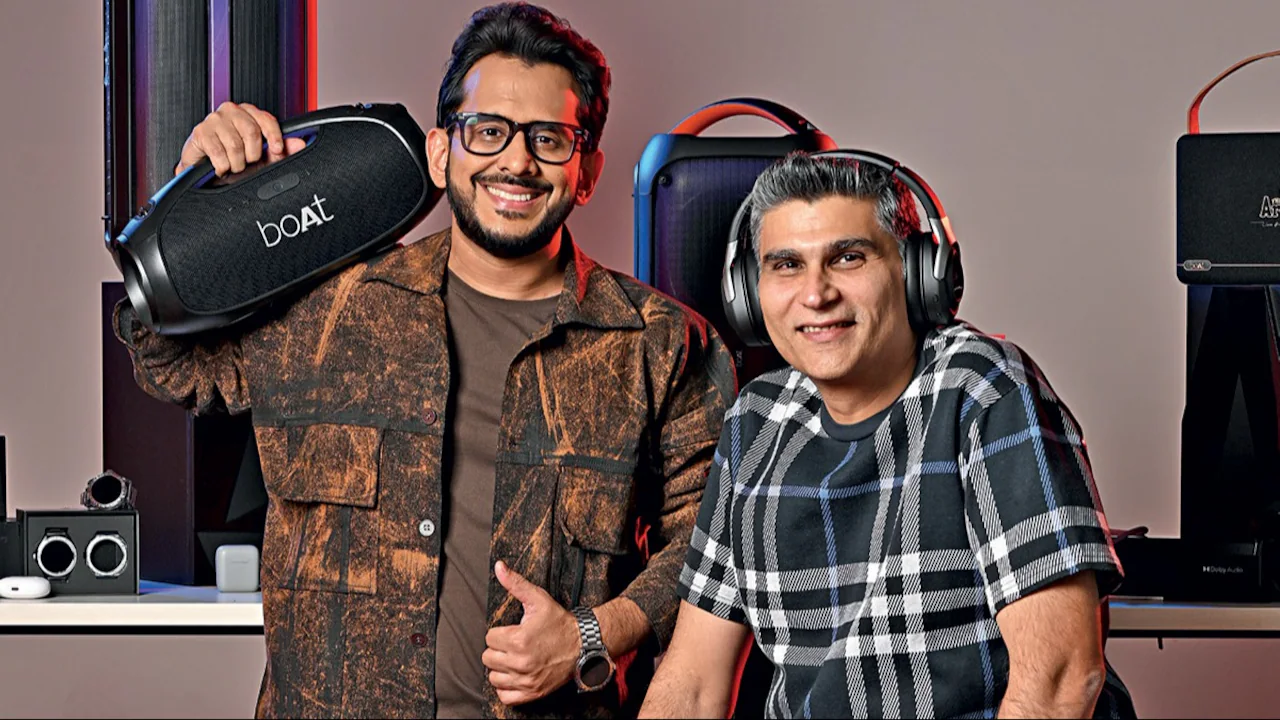
boAt founders Aman Gupta and Sameer Mehta built one of India's biggest consumer electronics brands by focusing on branding, affordability, and community.
Written by TFN Research Desk | covering startups, technology, digital media, and business strategy.
The story of how two founders turned a charging cable into India’s largest audio brand by mastering positioning, community, and distribution.
boAt did not invent earphones.
It did not invent Bluetooth speakers, smartwatches, or gaming headsets either.
It did not build a single factory. For years, it did not even manufacture the products it was selling.
Sony existed. JBL existed. Apple existed. Bose existed. Every product category boAt entered already had global giants with decades of engineering, hundreds of patents, and billions in brand equity.
And yet, by 2024, boAt held a 26.7% share of India’s wearable market more than Sony, more than Samsung, more than every global brand that had been here for decades.1
The startup that invented nothing had beaten everyone who invented everything.
Here is how.
How Did boAt Build a Billion-Dollar Brand?
boAt built a billion-dollar brand not by inventing new technology, but by understanding something every global audio company had missed: young Indians did not want the cheapest product or the most premium one. They wanted something stylish, durable, and affordable enough to buy without thinking twice and they wanted to feel cool doing it. By positioning itself as a lifestyle brand first and a tech brand second, boAt captured ₹3,000+ crore in annual revenue and became India’s number one audio and wearable company, heading toward an IPO targeting over ₹2,000 crore.2 3
Before boAt, There Was a Gap Nobody Wanted to Fill
Aman Gupta did not wake up one morning with a revolutionary idea. He woke up frustrated.
Before co-founding boAt in 2016, Aman had worked at Citibank, run a consumer electronics distribution startup that failed, and spent years at JBL as Director of Sales.4 That last job turned out to be the most important one on his resume, not because of what it taught him about audio technology, but because of what it taught him about the Indian market.
At JBL, Aman saw the gap up close. International brands were pricing their products for an Indian consumer who largely did not exist yet. A JBL speaker cost ₹5,000 to ₹15,000. A pair of Sony headphones cost ₹8,000. For an 18-year-old college student in Pune or Lucknow who just wanted decent audio to get through a commute, these were not realistic options.
The alternative was Chinese knockoffs. They were cheap and they broke within weeks. Every Indian who bought a ₹300 earphone from a street vendor in 2015 has a story about the wire fraying, the bass disappearing, or the left earbud dying on day three.
The market was split into two: unaffordable good products and affordable bad ones.
Nobody was standing in the middle.
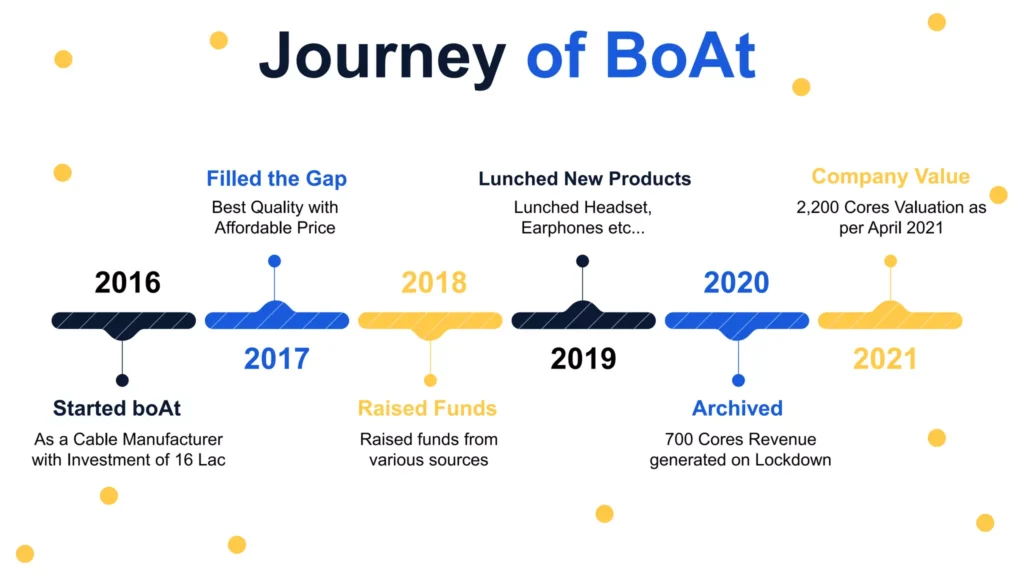
Aman called his old friend Sameer Mehta, who had built and sold businesses in gaming hardware distribution. They pooled ₹15 lakh each, registered a company called Imagine Marketing Services, and launched boAt.4
Their first product was not even a speaker or an earphone.
It was a charging cable.
What boAt Actually Built
The braided Apple charging cable that boAt launched in 2016 was not technologically interesting. It charged iPhones. It did not break easily. It looked better than the white cable Apple shipped in the box.
That was it. That was the entire product pitch.
But that cable told Aman and Sameer something important: Indian consumers would pay a slight premium for a product that did not feel cheap and did not die in a month. The cable sold. Then the earphones sold. Then the speakers. Then the smartwatches.
Each launch was not about introducing new technology. It was about introducing a new price point for quality that Indians were not being offered.
Here is what made boAt genuinely different from everything else in its category:
- The “Zara of electronics” positioning. Co-founder Sameer Mehta described boAt this way publicly: not luxury, not cheap, but premium-feel and inclusive.5 It was the first Indian consumer electronics brand that made you feel like you were buying something aspirational without spending like you were.
- Durability as the core promise. The entire brand built itself around one thing: products that do not break. The first cable, the first earphones, every product launch was accompanied by messaging around build quality. For a country where earphone wires routinely survived about three months, this was a genuine differentiation.
- Design that looked expensive. boAt put effort into colourways, finishes, and packaging that felt premium. The product in your hand looked like something that cost twice as much as it did. That visual gap between price and perception was the product.
- No factories, no problem. boAt outsourced manufacturing to contract manufacturers in China initially, then pivoted to India through a 50:50 joint venture with Dixon Technologies in 2022.6 The asset-light model kept costs low enough that boAt could price aggressively while still leaving margin to spend on what it actually cared about: marketing.
The Numbers That Rewrote the Category
| Metric | Figure |
|---|---|
| Founded | 2016 |
| First product | A braided Apple charging cable |
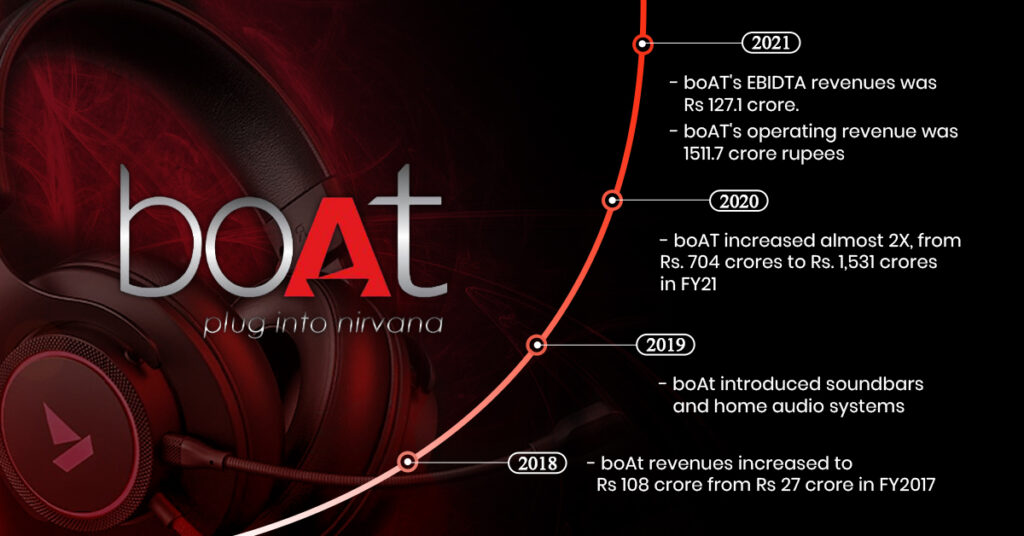
| Revenue FY2021 | ₹1,500 crore (5x growth in 3 years)6 |
| Revenue FY2023 (peak) | ₹3,376 crore2 |
| Market share in India wearables (Q2 2024) | 26.7%1 |
| Market share in India audio devices | 33%–36.8%7 |
| Community size (boAtheads) | 15 lakh+8 |
| Global wearable ranking | 5th largest brand9 |
| Total funding raised | ₹1,013 crore+6 |
| IPO target | ₹2,000 crore+3 |
| Net profit FY2025 | ₹61 crore (first sustained profit)7 |
The company that started with two founders and ₹30 lakh combined is heading to the public markets with India’s largest share of the wearables category, ahead of every global brand.
Why Sony and JBL Never Saw It Coming
Here is the uncomfortable truth about why global audio giants lost India’s mass market to a startup with no patents and no factories.
Sony and JBL were not building for India. They were building globally and distributing to India.
Their pricing reflected R&D amortised across Western markets where consumers earn in dollars. Their marketing was translated, not local. Their distribution was through electronics chains in malls in the top eight cities. The 19-year-old engineering student in Nagpur, the gym-goer in Bhopal, the content creator in Patna none of these consumers were in their target segment. They were statistical noise in a global spreadsheet.
boAt built for exactly that noise.
It priced for the Indian disposable income reality. It marketed in the language of Indian youth, which in 2017 meant cricket, Bollywood, and social media. It distributed online-first, which meant it could reach every pin code Amazon reached before boAt had a single offline store.
The global brands did not fail because they were bad at audio engineering. They failed because they were building the right products for the wrong country.
The boAtheads Army Nobody Talks About Enough
The most underrated strategic decision boAt ever made had nothing to do with a product.
It was a word: boAtheads.
Instead of calling its customers “users” or “consumers,” boAt gave them an identity. A boAthead was not someone who bought cheap earphones. A boAthead was someone who understood sound, lived actively, and did not compromise on style. The word carried aspiration. It carried belonging. It turned a transaction into a tribe.10
boAt built this community with a deliberate influencer architecture. At the top: Bollywood A-listers like Kiara Advani, Kartik Aaryan, and Rashmika Mandanna. In the middle: cricketers Hardik Pandya, KL Rahul, Shikhar Dhawan endorsed through a 2020 campaign that put boAt’s logo on six IPL team jerseys simultaneously.5 At the base: thousands of micro-influencers, fitness trainers, gaming YouTubers, college creators, and lifestyle bloggers, each talking to a community of 10,000 to 200,000 followers who trusted them more than they trusted any television advertisement.
The result was a brand that felt simultaneously mass and personal. Your favourite cricketer wore boAt. The fitness influencer you followed at 6 AM wore boAt. The tech reviewer who helped you pick your last phone wore boAt.
You did not need to see a billboard. boAt came to you through every screen you trusted.
What Almost Sank It
By FY2024, boAt’s revenue had fallen for consecutive years. Wearables, the category that had briefly powered explosive growth, dropped nearly 40% year-on-year to ₹550 crore.2
The problem was a familiar one for hardware brands. When you compete on price and design rather than proprietary technology, you are always one aggressive competitor away from irrelevance. Noise, the homegrown rival that boAt had always outpaced, was closing the gap in smartwatches. Chinese imports were pressing harder on the price floor.
boAt had also tried to IPO in 2022 and pulled back when market conditions turned. The company that had moved fast in its growth years now needed to prove something different: that it could be profitable, not just popular.
The response was textbook operational discipline. Expenses were cut. Inventory was managed conservatively. The wearables category was scaled back while audio, where boAt’s dominance was deepest, was defended.3
By FY2025, boAt posted a net profit of ₹61 crore, its first sustained return to profitability after years of losses.7
An IPO filing followed. SEBI approved the documents in August 2025.7
The brand that almost died in a category correction is heading to the public markets.
The Take Nobody In The Industry Wants To Say Out Loud
Our editors weigh in.
Let’s be honest about what boAt actually did.
It took someone else’s technology. Put it in a better-looking box. Priced it where no one else was willing to play. Then spent every rupee it had making sure a 22-year-old in Indore felt like a personality for owning it.
That’s it. That’s the whole thing.
And yet every Sony exec, every JBL distributor, every audio engineer with twenty patents to their name watched it happen and could not stop it. Because they were playing a completely different game. They were competing on specs. boAt was competing on identity.
Here’s what nobody in the consumer electronics industry will say out loud: the product was never the point.
The person wearing the earphones was the point. Whether they felt seen, whether they felt cool, whether the brand they chose said something about who they were. That is what boAt was selling. The audio was just the reason to put something in your ears.
Sony never figured that out. Not in India. Not for this generation.
And look, the next boAt is already out there. Right now. In some category that still has the same split: expensive and good on one end, cheap and broken on the other, with nothing in between. Fitness equipment, maybe. Eyewear. Kitchen appliances. Electric cycles. Take your pick.
Someone is going to walk into that gap, slap a community on top of it, get three cricketers to post about it, and build a ₹3,000 crore brand in five years.
The VCs will call it obvious in hindsight.
It always is.
Frequently Asked Questions
Who founded boAt?
Aman Gupta and Sameer Mehta co-founded boAt in 2016 under their parent company Imagine Marketing Services Private Limited.4
What was boAt’s first product?
A braided, durable charging cable for Apple devices not an earphone or a speaker. The cable’s success gave the founders confidence to expand into audio.4
Does boAt manufacture its own products?
Not initially. boAt started with contract manufacturers in China, then in 2022 entered a 50:50 joint venture with Dixon Technologies to manufacture Bluetooth audio devices in India.6
Who are boAt’s biggest rivals?
Noise is the closest domestic rival with ₹1,439 crore in FY24 revenue. Globally, Samsung, Sony, Apple, and JBL compete in overlapping categories, though none match boAt’s dominance in India’s mass-market segment.6
What is a boAthead?
boAtheads is the name boAt gives its community of customers and fans, building a sense of identity and belonging around the brand rather than just a product relationship.10
Is boAt going public?
Yes. boAt filed its DRHP with SEBI, received regulatory approval in August 2025, and is targeting an IPO of over ₹2,000 crore.3 7
Is boAt profitable?
boAt returned to profitability in FY2025, posting a net profit of ₹61 crore after narrowing losses in FY2024.7
How large is boAt in India?
As of Q2 2024, boAt holds a 26.7% market share in India’s wearables category, making it the country’s number one brand, ahead of every global competitor.1
Stay in the Loop
For more stories, breakdowns, and unfiltered takes on what is really happening in Indian business and tech, follow The Founder Nation.
Instagram Handle : https://www.instagram.com/thefoundernation?igsh=MTZobDUwc2xqZWdhOA==
We cover what the mainstream business press won’t.
© TheFounder Nation | All rights reserved
Word count: ~1,800 | Read time: ~7 minutes
Primary keyword: How boAt built a billion-dollar brand | Secondary: boAt success story, boAt business model, boAt vs Sony JBL India, boAt marketing strategy, boAtheads community, Aman Gupta boAt, boAt IPO