

The following is a fictional but research-grounded interview with a composite angel investor, constructed from patterns across India’s active angel community. The views represent how experienced Indian angels evaluate founders — not a statement from any single individual.
There is a version of angel investing that looks effortless from the outside.
A founder walks into a room, tells a compelling story, shows a slide with a hockey stick, and walks out with a cheque. That version exists mostly in Shark Tank edits.
The actual decision happens differently. It happens in the two minutes after the founder leaves and the investor sits quietly with the question: would I trust this person with my money, my network, and my reputation for the next seven years?
That question is personal in a way that VC investing rarely is. An angel investor is writing a personal cheque. There is no investment committee to share the blame. No LP reporting structure to hide behind. The bet is almost entirely on a reading of another human being, at a stage when most of the other evidence is thin.
We sat down with an angel investor who has backed more than 40 early-stage Indian startups to understand what that reading actually looks like, what they are looking for, and what most founders still get wrong.
TFN: You have backed over 40 companies. What is the one thing that most consistently predicted whether a founder would build something worth backing?
Relationship to the problem.
Not passion. Not intelligence. Not the deck quality or the market size or the advisors they have lined up. The single most reliable signal I have found in a first conversation is whether the founder knows something about the customer that I do not, that they could only know from sustained, close contact with the problem.
When a founder building logistics software for kirana stores can tell me three specific things about how a kirana owner thinks about cash flow on a Thursday afternoon in a Tier-3 town, I am listening differently than when they tell me the Indian FMCG distribution market is worth ₹10 lakh crore. The first one is a signal of deep proximity. The second one is a signal they read a report.
Founder quality accounts for thirty to forty percent of how I actually make a decision at the pre-revenue stage. That is the most important single variable when there is not much else to evaluate. And the way I test it is not a formal question. It is a conversation about the customer.
TFN: What does that conversation look like in practice?
I ask founders to describe the last time they spoke to a customer, what that customer said, and what surprised them about it. The answer tells me several things at once.
First, whether they are talking to customers at all. You would be surprised how many founders at the seed stage have stopped doing customer conversations because they are convinced they already understand the problem. That conviction is almost always premature.
Second, how they process what they hear. The founders I want to back update their thinking based on customer conversations. They come into the meeting with a view that has shifted in the last two weeks because of something a user told them. The ones who are not updating are not listening. And a founder who does not listen to customers will eventually not listen to me either.
Third, whether they are honest about what they do not know. The best founders I have backed have all said some version of “we assumed X, but we found out it is actually Y, and that changed how we think about Z.” That ability to be surprised, to hold a hypothesis loosely, is one of the most important qualities in an early-stage founder. It is the opposite of the founder who has a completely fixed view and defends it against every question in the room.
TFN: You mentioned not listening to investors as a warning sign. How important is coachability to you?
I want to be careful here because coachability is one of the most misused words in the angel investing vocabulary.
What I am not looking for is a founder who agrees with everything I say. That is a red flag, not a green one. A founder who capitulates to every investor opinion does not have the conviction to build through the hard parts. And the hard parts always come.
What I am looking for is a founder who listens. Really listens. Who can take in a perspective that challenges their assumptions, sit with it for a moment, and then give me a considered response about whether it changes their thinking and why. The ones who dismiss everything immediately have stopped being curious. The ones who agree with everything are performing, not thinking. The ones I want to back are the ones who say: “That is interesting. I had not thought about it from that angle. Let me explain how I have been thinking about it, and tell me if I am missing something.”
That quality matters more than any credential. I have backed founders with no prior startup experience who had that quality, and passed on founders with two exits who did not.
TFN: Angel investing in India saw deal volume fall 44% in 2025. How has that changed what you look for?
It has raised the bar on everything, but especially on traction. When capital was flowing freely, I was willing to back founders at a very early stage with almost no product validation. A compelling founder with a well-framed problem was enough. That window is largely closed.
Today I want to see at minimum a working product that someone is using, and ideally evidence that at least one person has paid for it. Not because revenue is the only signal that matters, but because the act of getting a first paying customer tells me more about a founder than almost anything else. It shows they can sell, which is underrated at the seed stage. It shows the problem is real enough for someone to spend money on. And it shows they have built something functional rather than just designed something beautiful.
India’s angel ecosystem saw over 800 deals in 2025, and the investors who remain active after the deal volume correction are more selective and more focused on quality. For founders, that means the days of raising on a deck and a dream are mostly over. Show me the product. Show me the user. Show me what happened when the first person tried to use it and what you changed.
TFN: What kills a deal for you, even when you like the founder?
Three things.
The first is a mismatch between what the founder says they know and what they actually know. If a founder tells me they deeply understand enterprise sales in India but cannot explain a typical enterprise sales cycle, the conversion rate, or the average contract value of their existing pipeline, the credibility of everything else they say goes down. Angels do reference checks. Not always formally, but always. We call people in our network who have worked with the founder, who know the industry, who have seen the team operate. What we hear in those calls, and how it matches or contradicts what the founder told us, shapes the final decision more than the pitch did.
The second is a valuation that signals the founder has not thought seriously about the investor’s return math. An angel cheque in India typically ranges from ₹10 lakh to ₹2 crore. At the stage I invest, I need a realistic path to a return that justifies both the risk and the illiquidity of holding for five to seven years. A founder who opens at a valuation that makes that math impossible, without being able to justify it with traction, is telling me they have not done the work of understanding what they are asking for.
The third is any signal that the founder is not being straight with me. I can tolerate uncertainty. I cannot tolerate a founder who shapes the truth to match what they think I want to hear. The earliest form of this is in how they talk about their competition. Founders who say they have no real competition have either not done the research or are not being honest. Every problem that is worth solving has people trying to solve it. The ones who can name their competitors, explain why those approaches fall short, and articulate the specific edge their company has are the ones I trust.
TFN: What about team? At the angel stage, you are often betting on one or two people with no track record. How do you evaluate that?
I look for what I call founder-market fit, which is different from product-market fit and usually precedes it.
Founder-market fit is the question: why is this person the one who is going to win this market? Not why is the product good. Why is this founder, specifically, the one who will outwork, outlearn, and outnavigate everyone else trying to solve the same problem?
The answer sometimes comes from domain expertise, having worked in the industry for years and understanding it from the inside in a way that outsiders cannot replicate quickly. Kunal Shah at CRED brought years of fintech operator experience and a deep understanding of credit behaviour in India. Anupam Mittal built Shaadi.com with an intimate knowledge of how Indian families make decisions about marriage. Both had an unfair advantage in their respective markets before they raised a single rupee.
But founder-market fit also comes from obsession. A founder who has been trying to solve this problem for two years, who has read everything, talked to everyone, and built three failed prototypes before the one they are showing me, has earned a kind of conviction that is hard to manufacture. That obsession is its own form of advantage.
What I am least interested in is a founder who got excited about a sector because an investor told them it was hot. Those companies rarely build the kind of deep insight that produces a durable business.
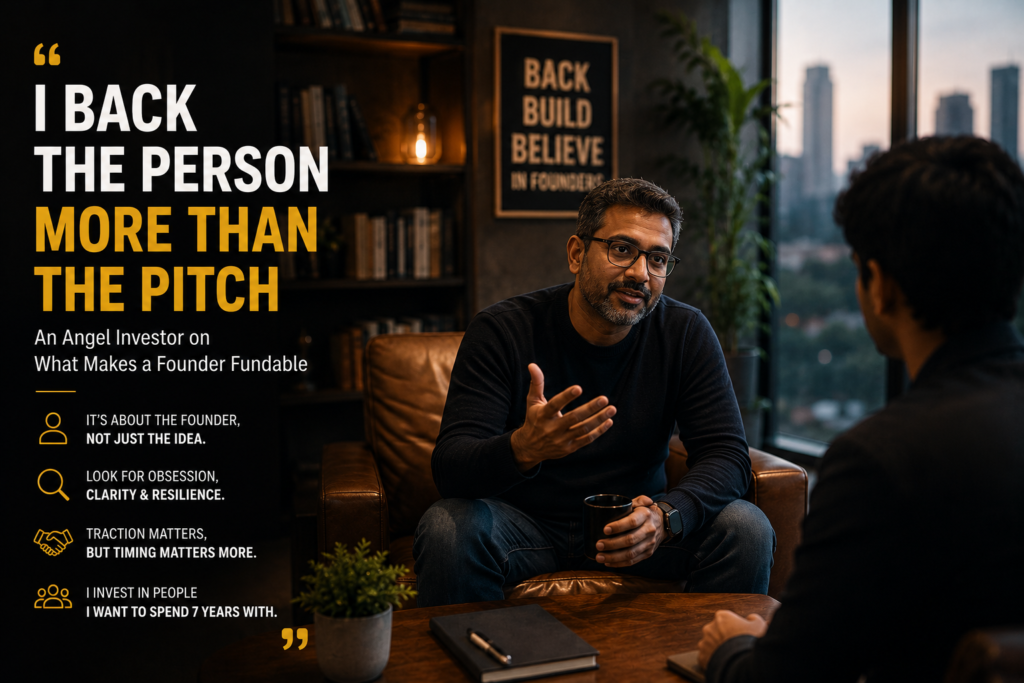
TFN: You back founders, not just companies. What does that mean in practice for how you show up after the cheque?
It means I am available. That sounds obvious and it is mostly not what happens.
The most useful things I do for my portfolio are introductions, not advice. An introduction to the right potential customer, the right follow-on investor, the right hire. Those introductions happen because I have been building a network for twenty years that the founder does not have yet. That is the real value of an angel who has operated in the industry.
The advice part is more complicated. I try to be honest when I see something I think is wrong. But I also try to hold my opinion loosely, because the founder knows their company and their customer far better than I do. The angels I have seen do the most damage are the ones who treat their portfolio companies like employees and their investment like authority. It is not. The founder has to make the decisions. My job is to make sure they have good inputs.
What I expect in return is honesty. Tell me when something is not working before it becomes a crisis. Tell me when you are uncertain about a decision before you make it, not after. The founders I have the best relationships with are the ones who communicate like partners, not like they are managing investor sentiment.
TFN: What should a founder do differently before walking into a meeting with an angel?
Research the angel, not just their portfolio.
Every angel has a pattern. Look at the companies they backed, when they backed them, and at what stage. Look for the common thread. A founder who backed six B2B SaaS companies in the healthcare compliance space across five years has a real conviction about that space. A founder walking into that meeting with a consumer health app is wasting both of their time.
Beyond the portfolio, look at what the angel has said publicly. Many of India’s most active angels, including Kunal Shah with over 287 investments and Anupam Mittal with 245-plus, have spoken extensively about what they look for and what they have learned. That material is public. A founder who has absorbed it and can engage with the angel’s thinking, not just their money, is a fundamentally different conversation.
The founders who impress me most in first meetings are the ones who say: “I looked at your portfolio and noticed you have backed three companies in adjacent spaces. I thought about whether that creates a conflict and concluded it does not, for these reasons. But I wanted to ask you directly.” That level of preparation signals something about how they run their company.
What This Means If You Are Raising from Angels
Angel investing in India is personal in a way that institutional investing is not. The cheque comes from a person, not a fund. And that person is evaluating you across a set of dimensions that are mostly human rather than financial.
The founders who close angel rounds are not always the ones with the best product or the biggest market. They are the ones who are honest about what they know and do not know, who can demonstrate proximity to the customer in a way that feels earned, who treat the meeting as the beginning of a relationship rather than a transaction.
India’s angel ecosystem is rebuilding after a contraction. The investors who are active in 2026 are experienced, selective, and paying attention to quality signals that might have been overlooked when capital was cheaper. For founders, that environment is harder to raise in and more valuable to raise from. The angels who are writing cheques today are doing it with conviction, and conviction from the right angel is worth more than the rupees in the cheque.
Frequently Asked Questions
What is the difference between an angel investor and a VC in India? An angel investor writes a personal cheque, typically between ₹10 lakh and ₹2 crore, from their own money. A VC deploys capital from a fund raised from limited partners. The practical difference for founders is that angel decisions are faster, more personal, and driven by the investor’s own conviction rather than an investment committee. Angels in India also often bring operator experience alongside capital, which can be more valuable than the money at the pre-seed stage.
How do Indian angels typically find startups to invest in? Primarily through networks. Warm introductions from fellow founders, accelerator connections, and community events like those hosted by LetsVenture, Indian Angel Network, or iSPIRT are the most common entry points. Cold outreach rarely works for angel funding in India because the relationship layer matters more here than in institutional fundraising. IPV, India’s most active angel platform in 2025 with 46 investments, and networks like Mumbai Angels are also structured channels that founders can approach with a formal application.
What traction do angels expect before writing a cheque? It depends on the angel and the stage, but the bar has moved up since the 2024 to 2025 market correction. Most active angels in India now want to see a working product, some user adoption, and ideally at least one paying customer. A founder who can show the sales conversation that produced the first revenue, including what objections came up and how they were addressed, is telling a more convincing story than any slide about market potential.
How do angels do reference checks on founders? Informally but consistently. They reach out through shared connections to people who have worked with the founder, invested alongside them before, or know them from the industry. They talk to customers the founder has mentioned. They sometimes speak to co-founders, current or former. The best way to handle this is to proactively offer references and to make sure that the people you mention as references are genuinely prepared to speak well and specifically about you. Founders who are caught saying something in the pitch that does not match what references say rarely recover from it.
How important is the co-founder in an angel’s evaluation? Very important, though not always explicitly discussed. Angels are betting on a team’s ability to operate under pressure for five to seven years. A founding team that appears to have complementary skills, a clear division of responsibility, and an honest read on each other’s weaknesses is significantly more fundable than a solo founder or a pair where one person clearly dominates every answer. Co-founders who speak over each other, contradict each other without resolution, or cannot explain why the equity split is what it is are all signals that the working relationship has not been stress-tested.
What is the biggest mistake founders make when pitching angels? Overselling certainty. Angels are experienced enough to know that early-stage companies are full of unknowns. A founder who presents a future with no ambiguity is either not being honest or has not thought rigorously about what could go wrong. The founders who close rounds from serious angels are the ones who say: “Here is what we know, here is what we are still figuring out, and here is how we are going to resolve the uncertainty.” That framing builds trust faster than any hockey stick slide.
References
- Indian Angel Network (IAN). Official Website – Angel Investment Process, Portfolio & Founder Resources.
https://www.indianangelnetwork.com/ - Inflection Point Ventures (IPV). Official Website – Angel Investment Platform & Portfolio.
https://ipventures.in/ - LetsVenture. Official Website – Angel Investing Platform, Syndicates & Founder Resources.
https://letsventure.com/ - Kunal Shah. Official Blog & Public Talks on Startups, Investing and Entrepreneurship.
https://kunalshah.in/ - Anupam Mittal. Official Website – Entrepreneur, Angel Investor & Startup Insights.
https://anupam.com/ - First Round Capital. First Round Review – Founder Evaluation & Early-Stage Investing.
https://review.firstround.com/ - Y Combinator. Startup Library – Founder-Market Fit, Fundraising & Early-Stage Advice.
https://www.ycombinator.com/library - Venture Deals. Brad Feld & Jason Mendelson. Venture Deals: Be Smarter Than Your Lawyer and Venture Capitalist. Wiley.
Stay in the Loop
For more stories, breakdowns, and unfiltered takes on what is really happening in Indian and global business and tech, follow TheFounder Nation.
Instagram Handle : https://www.instagram.com/thefoundernation?igsh=MTZobDUwc2xqZWdhOA==
We cover what the mainstream business press won’t.
© TheFounder Nation | All rights reserved Word count: ~1,750 | Read time: ~8 minutes Primary keyword: what angel investors look for in founders India | Secondary: angel investor India 2026, how to get angel funding India, angel investor evaluation criteria, Kunal Shah angel investor, Anupam Mittal investments, Indian Angel Network, founder market fit, angel investing India 2025